

Yes. You can arrange for a professional caregiver to stay with your elderly parent while you go on vacation. Depending on their needs and provider availability, temporary in-home care may include scheduled visits, overnight assistance, or continuous coverage by caregivers working in shifts.
The flights are booked, the suitcase is out, and then the questions begin. Who will make sure Dad eats dinner? What happens if Mom needs help getting to the bathroom at night? Is a neighbor stopping by really enough?
These are practical concerns, even when your parent insists they will be fine. Temporary home care for elderly parents can help cover the daily responsibilities you normally handle, allowing your parent to remain in familiar surroundings while you travel.
For Indianapolis families, the first step is matching the care schedule to your parent’s actual routine. Here is how to choose the right arrangement, prepare for your trip, and avoid gaps in support.
What Is Temporary Home Care for Elderly Parents?

Temporary home care provides support for a defined period, such as a weekend, a weeklong vacation, or a longer absence. When it gives a regular caregiver time away from caregiving, it is often called respite care.
The National Institute on Aging explains that respite care can take place at home, in a healthcare facility, or at an adult day care center. The setting depends on the person’s needs and the services available.[1]
Vacation respite care is planned around your departure and return dates. An agreed care plan should specify who will visit, when they will be present, and what assistance they will provide.
An occasional companion visit and continuous supervision are very different arrangements. Ask for the actual schedule in writing rather than relying on phrases such as “someone will be there.”
Why Should Family Caregivers Plan Time Away?
Caregiving often fills the small spaces in a day: a morning phone call, an evening meal, a pharmacy pickup. When you plan a vacation, you suddenly see how many responsibilities depend on you.
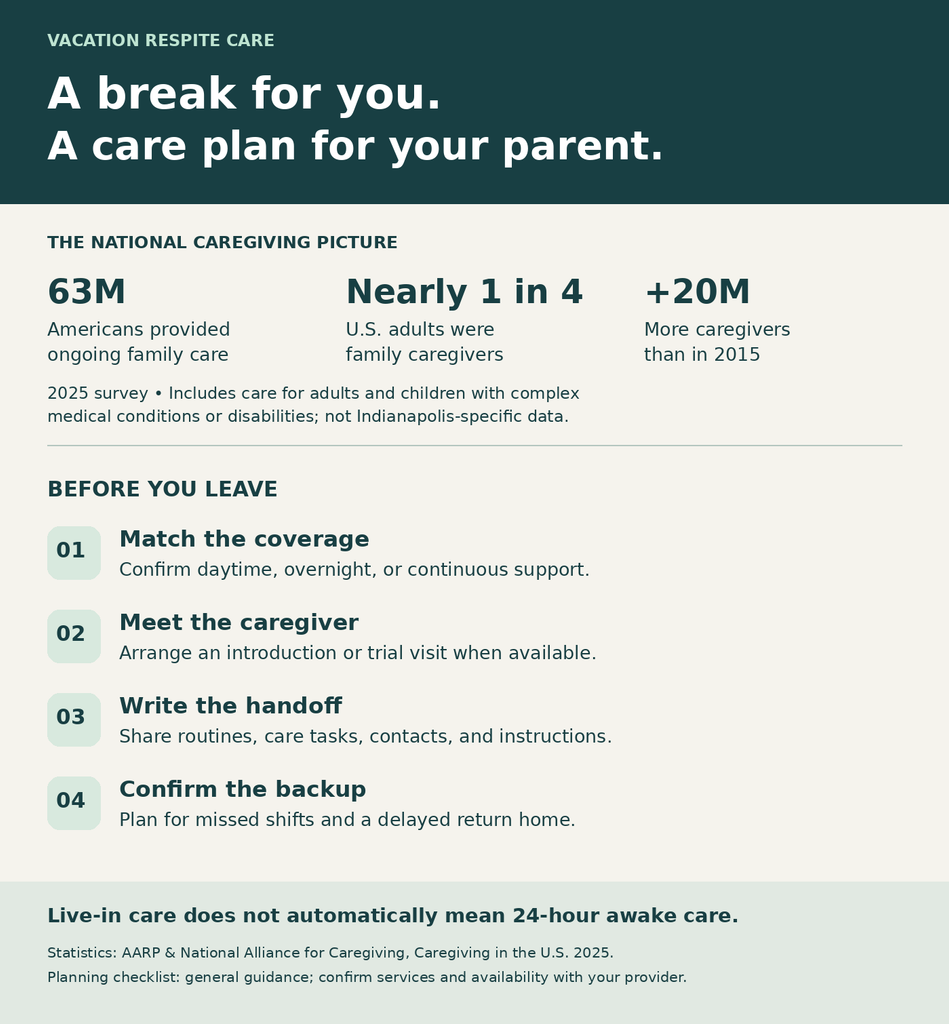
The 2025 AARP and National Alliance for Caregiving report found that 63 million Americans—nearly one in four adults—provided ongoing care to an adult or child with a complex medical condition or disability in the previous year. That was an increase of approximately 20 million caregivers compared with 2015.[2]
These are national figures covering a broad caregiving population, not statistics specific to older parents or Indianapolis. They help explain why reliable relief for family caregivers matters.
You do not need to wait until you are exhausted to arrange help. Planning a break gives you time to introduce another caregiver, discuss your parent’s preferences, and work through concerns before departure.
What Type of Care Does My Parent Need While I Am Away?
Choose coverage based on the help your parent needs throughout a full day and night. Age alone does not determine whether scheduled visits, overnight support, or continuous care is appropriate.
Think about an ordinary week. Include the tasks you do automatically, such as setting out breakfast or helping your parent get ready for bed.
| Care arrangement | When it may fit | What to confirm |
|---|---|---|
| Scheduled daytime visits | Your parent can safely spend time alone but needs help with meals, companionship, or personal care | Exact visit times and support between visits |
| Overnight care | Your parent needs someone present overnight or assistance during nighttime hours | Whether the caregiver stays awake and which hours are covered |
| Continuous 24-hour care | Your parent needs supervision or help throughout the day and night | Shift coverage, handoffs, and backup staffing |
| Live-in arrangement | An assessed plan allows a caregiver to stay in the home with defined rest periods | Sleep time, breaks, and who covers any gaps |
| Residential respite stay | Care at home cannot meet your parent’s needs, or a temporary facility stay is preferred | Admission requirements, staffing, clinical services, and availability |
A live-in caregiver does not automatically mean an awake caregiver is available every minute. If your parent needs repeated help overnight, ask specifically about awake overnight staffing and how daytime coverage will work.
For example, a parent who safely manages personal care may only need meal preparation and companionship. A parent who cannot get out of bed without help needs a plan that covers every time that assistance may be necessary.
If you are unsure whether your parent can safely be alone, discuss the situation with their healthcare professional and the care provider before finalizing travel arrangements.
What Can a Caregiver Do While Family Is Away?

Depending on the agency’s services, caregiver training, and agreed care plan, non-medical support may include:
- Companionship and familiar activities.
- Meal preparation and routine reminders to eat and drink, consistent with existing instructions.
- Help with bathing, dressing, grooming, and toileting.
- Mobility assistance within the caregiver’s training and the care plan.
- Light housekeeping and laundry related to daily care.
- Medication reminders, where permitted.
- Agreed updates to family members.
Be specific when arranging a caregiver while family is away. “Help with meals” might mean warming a prepared lunch, cooking dinner, or providing hands-on eating assistance. Explain what your parent actually needs.
Non-medical home care and skilled home health care also serve different purposes. Do not assume a companion caregiver can give injections, perform wound care, or make medication decisions. Ask which tasks require a licensed healthcare professional and arrange that care separately when needed.
Can My Parent With Dementia Stay Home During My Vacation?

Temporary in-home care may be an option for a parent with dementia, but the arrangement must match their supervision needs, routines, and behavior. A familiar home does not eliminate the need for appropriate staffing.
Tell the provider about wandering, nighttime waking, distress, resistance to personal care, and any difficulty recognizing hazards. Ask about the proposed caregiver’s experience with those specific needs.
Arrange an introduction before you leave when possible. Share familiar meals, preferred activities, comforting topics, and approaches your parent responds to well. The National Institute on Aging identifies respite services as one source of help for Alzheimer’s caregivers.[3]
A camera, door alert, or scheduled phone call cannot provide hands-on help when your parent needs it. Use technology only as part of an appropriate care arrangement.
How Do I Prepare My Parent for Vacation Respite Care?
1. Include Your Parent in the Conversation
Explain when you will be away and what help you are arranging. Ask which routines they want to keep and what would make having someone in the home more comfortable.
Instead of “You can’t manage without me,” try: “I’d like someone to help with dinner and be available during the evening while I’m away.” Keep the conversation honest and respectful.
2. Arrange an Introduction or Trial Visit
If available, book a visit before the trip. Let your parent and caregiver meet while you are present, then give them room to become comfortable with each other.
A trial visit also helps reveal practical details: a difficult front-door lock, a walker that cannot pass easily through a doorway, or a bedtime routine that takes longer than expected.
3. Write a Clear Care Handoff
Prepare one accessible document with:
- Daily routines, meal preferences, allergies, and existing care instructions.
- A current medication list and the person responsible for each medication task.
- Personal care, mobility, and supervision needs.
- Healthcare provider and pharmacy contact details.
- Your travel contact information and a local backup contact.
- Relevant emergency documents and the location of supplies.
- Home access instructions and the agreed communication schedule.
Only share sensitive information with people who need it to provide care. Make sure the provider understands the instructions rather than simply receiving a long folder on your way out.
4. Confirm Backup Coverage
Ask what happens if the assigned caregiver becomes sick or cannot arrive. Get the after-hours contact number and clarify who arranges replacement coverage.
Plan for your own delays, too. A canceled flight should not leave a parent who needs supervision without support. Discuss how an extension would be requested, whether staffing could be available, and how it would be billed.
How Much Does Temporary In-Home Care Cost?
The total depends on the hours requested, level of assistance, staffing arrangement, minimum booking requirements, and any additional charges. Ask for a written quote covering your entire absence.
For an hourly arrangement, a useful starting calculation is:
Hourly rate × scheduled hours per day × number of days, plus applicable fees.
Five days with six hours of daily support equals 30 scheduled care hours. Five full days of continuous coverage equals 120 hours. These are scheduling examples, not price quotes, and they show why the coverage plan matters as much as the hourly rate.
Ask whether the estimate includes weekend or holiday charges, transportation expenses, assessment fees, cancellation terms, and changes to the return date. If care is quoted as a daily package, confirm exactly what that package covers.
Will Medicare or Indiana Medicaid Pay for Vacation Respite Care?
Do not assume routine vacation coverage will be paid by Medicare. Medicare’s home health benefit does not pay for 24-hour care at home or personal care when that is the only care needed. Check directly with a Medicare Advantage plan about any additional benefits.[4]
Hospice has a separate respite provision: the National Institute on Aging notes that Medicare can cover most of the cost of up to five consecutive days of respite in an eligible inpatient setting for someone receiving hospice care. This is different from arranging a caregiver to stay in the family home.[1]
For Indiana families, PathWays for Aging lists respite among additional services available to members who meet functional eligibility requirements. Contact your parent’s health plan or service coordinator to ask about eligibility, authorization, covered hours, and participating providers before booking care.[5]
Existing program enrollment does not establish that your requested vacation schedule is approved. Confirm the specific arrangement in advance.
How Do I Choose Short-Term Senior Care in Indianapolis?
When comparing providers for short-term senior care in Indianapolis, start with your parent’s needs and your exact dates. Confirm service availability at the home address, including the relevant Indianapolis neighborhood or surrounding Central Indiana community.
Ask these questions before committing:
- Can you cover every date and time in the proposed schedule?
- What screening and training do caregivers receive?
- Can the assigned caregiver handle my parent’s specific support needs?
- Who supervises care and responds after hours?
- How are missed shifts and staffing changes handled?
- How will I receive updates, with my parent’s consent?
- What services, costs, and cancellation terms will appear in writing?
Contact Indy In-Homecare to discuss your parent’s routine, travel dates, and non-medical support needs. Ask about current availability, service coverage, and whether the requested arrangement can be accommodated.
Frequently Asked Questions
Can I Arrange Care for Just a Weekend?
Some providers offer short bookings, including weekends, subject to minimum hours and staffing availability. Confirm coverage before relying on it, especially when overnight help is needed.
Can Someone Stay With My Parent Overnight?
Yes, if a provider offers that service and can meet your parent’s needs. Ask whether the caregiver is awake throughout the shift, allowed to sleep, or available only during specified hours.
How Early Should I Book Vacation Respite Care?
Contact providers as soon as you know your travel dates. Allow time for an assessment, a written plan, caregiver matching, and an introduction. Availability varies, so there is no universal booking window.
What if My Parent Says They Do Not Need Help?
Ask what concerns them about accepting care. Start with specific tasks they would welcome help with, such as cooking or laundry, and involve them in choosing the arrangement. If safety or decision-making ability is a concern, seek guidance from their healthcare professional.
Will I Get Updates While I Am Away?
Agree on this before departure. Specify who receives updates, how often they are sent, and which concerns require an immediate call. Respect your parent’s privacy and consent preferences.
Plan Your Trip With a Clear Care Arrangement
Temporary home care for elderly parents works best when the details are settled before departure: a suitable care schedule, a familiar routine, clear responsibilities, and a backup plan.
You should know who will arrive, what they will do, and whom to call if something changes. Your parent should know what to expect as well.
Planning a vacation? Contact Indy In-Homecare to discuss temporary care options for your parent in Indianapolis and the surrounding area. Share your dates and care needs, and request a written plan and quote before you travel.
Sources
- National Institute on Aging: What Is Respite Care?
- AARP and National Alliance for Caregiving: Caregiving in the U.S. 2025 report announcement
- National Institute on Aging: Getting Help With Alzheimer’s Caregiving
- Medicare: Home Health Services Coverage
- Indiana FSSA: PathWays for Aging Frequently Asked Questions